
 Vietnam
 Thailand


The only Asian team ever to reach the FIFA World Cup semi-finals — amid enormous controversy
The 2002 FIFA World Cup was jointly hosted by South Korea and Japan. It was the first World Cup ever held in Asia and also the first to be co-hosted by multiple countries. The tournament format remained the same as the previous edition: 32 teams were divided into eight groups, with the top two teams from each group advancing to the knockout stage. If a knockout match went into extra time, the “golden goal” rule was applied. The groups were as follows:
2002 FIFA World Cup logo
Group A: France, Denmark, Uruguay, Senegal
Group B: Spain, Slovenia, Paraguay, South Africa
Group C: Brazil, Turkey, China, Costa Rica
Group D: South Korea, Poland, Portugal, United States
Group E: Germany, Republic of Ireland, Saudi Arabia, Cameroon
Group F: Argentina, England, Sweden, Nigeria
Group G: Italy, Croatia, Ecuador, Mexico
Group H: Japan, Belgium, Russia, Tunisia
There were four debutants at the 2002 FIFA World Cup: Ecuador, Senegal, Slovenia, and China. Among them, China attracted the most attention.
China’s qualification for the World Cup was the result of several factors coming together. First, co-hosts South Korea and Japan qualified automatically, which meant China avoided two major rivals in the Asian qualifiers. In addition, during the final round draw of the Asian qualifying tournament, Zhang Jilong, then vice chairman of the AFC competition committee, helped China land a highly favorable group, allowing them to avoid strong teams such as Iran and Saudi Arabia and greatly reducing the pressure on the team.
At the same time, the Chinese national team itself had reached a respectable level of strength, while head coach Bora Milutinović did an excellent job preparing the players mentally. As a result, China qualified for the FIFA World Cup finals for the first time in history, an achievement that many saw as a natural culmination of the team’s progress.
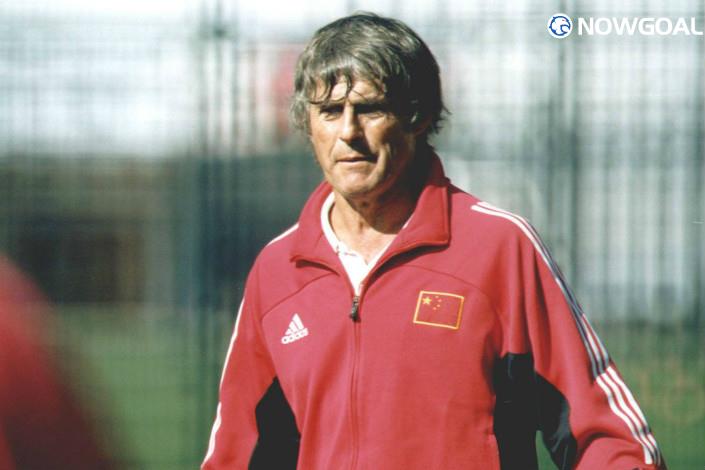
Bora Milutinović led China to qualify for the FIFA World Cup for the first time in the nation’s history
Before the tournament, the Chinese team set themselves the goal of “scoring one goal, earning one point, and winning one match.” They believed they had a chance to defeat Costa Rica, draw with Turkey, and narrowly lose to Brazil, which could have been enough to qualify from the group in second place. However, once the matches began, China quickly realized the enormous gap between themselves and the world’s top footballing nations. In the end, China lost all three matches, conceded nine goals, and failed to score even once before being eliminated. Had Saudi Arabia not suffered an even worse campaign, China would have finished bottom of the overall standings at the tournament.
Although both China and Saudi Arabia endured heavy defeats, Asian football as a whole achieved a breakthrough at the 2002 World Cup. Japan, only participating in their second World Cup, reached the Round of 16. South Korea, who had never previously won a World Cup match in five earlier appearances, stunned the world by reaching the semi-finals. However, their historic run was also accompanied by major controversy.
One year before the Korea–Japan World Cup, the Korea Football Association appointed renowned Dutch coach Guus Hiddink as head coach of the national team. During his time managing PSV Eindhoven, Hiddink had won the UEFA Champions League and achieved a historic continental treble. He also briefly managed Spanish giants Real Madrid CF. Yet his reputation and résumé did not make him untouchable. Korean media were initially dissatisfied with his management, criticizing him for not appearing fully committed to the job.
At first, South Korea’s performances under Hiddink were indeed disappointing. In the 2001 FIFA Confederations Cup, they suffered a humiliating 5–0 defeat to France. In 2002, as a guest team invited to the CONCACAF Gold Cup, they played five matches and lost three of them. At the time, there were even public calls for Hiddink to be dismissed before the World Cup. Nevertheless, he ignored the outside pressure and continued carrying out his plans step by step.
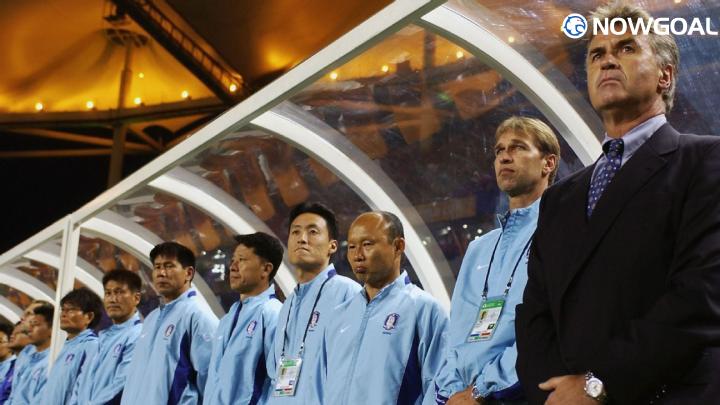
Guus Hiddink achieved tremendous success as head coach of South Korea
Korean football culture traditionally placed great importance on seniority. Within the national team, veteran players tended to stay together while younger players formed their own separate groups. Hiddink deliberately broke down these divisions, encouraging older and younger players to interact more often and speak openly about their ideas. In this way, he strengthened the team’s unity and cohesion. He also placed enormous emphasis on physical conditioning so that Korean players could maintain their intensity throughout high-level matches. Later events proved that South Korea’s superior fitness became one of their greatest weapons.
In the group stage, South Korea defeated Poland 2–0, drew 1–1 with the United States, and beat Portugal 1–0 to finish top of the group and advance to the Round of 16. One particularly notable moment came in the match against Portugal, where the referee sent off two Portuguese players. The first red card caused little controversy, as midfielder João Pinto committed a reckless tackle from behind on Park Ji-sung.
The second dismissal, however, sparked debate. Portuguese defender Beto was judged to have fouled Korean full-back Lee Young-pyo and received a second yellow card. Replays suggested that Lee may have exaggerated the contact and possibly simulated the foul. Forced to play with only nine men from the 66th minute onward, Portugal eventually conceded the decisive goal to Park Ji-sung, lost the match, and were eliminated from the tournament.
In the Round of 16, South Korea faced Italy at the Daejeon World Cup Stadium. Korean fans displayed a striking banner in the stands that read:
“Back to 1966”
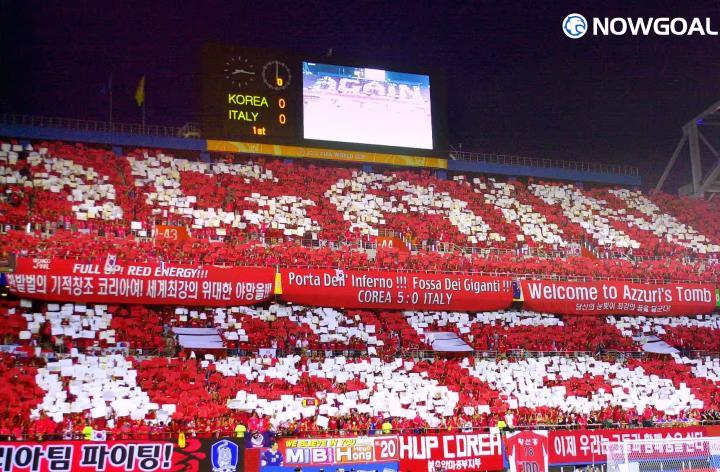
Korean fans displayed banners reading “Back to 1966.”
At the 1966 World Cup, Italy had suffered a shocking 1–0 defeat to North Korea, South Korea’s compatriots on the Korean Peninsula. That match became such a nightmare for Italian football that even the word “Korea” could trigger painful memories among Italian fans. To make matters worse, Italy entered this game without two key central defenders: Alessandro Nesta was injured, while Fabio Cannavaro was suspended. Their absence created major concerns in defense.
Sure enough, just four minutes into the match, Italian defender Christian Panucci conceded a penalty. South Korean striker Ahn Jung-hwan stepped up to take it, but his shot was saved by legendary Italian goalkeeper Gianluigi Buffon. Having escaped early danger, Italy soon took the lead when Christian Vieri scored with a header. After scoring, Vieri faced the roaring home crowd and put his finger to his lips in a “quiet down” gesture.
In the second half, South Korea became increasingly aggressive as they pushed for an equalizer, while Italy gradually retreated deeper in an attempt to protect their lead. Then, in the 88th minute, trouble struck Italy again through Panucci. While trying to clear a Korean cross, he accidentally tripped his own teammate. Korean forward Seol Ki-hyeon seized the opportunity and fired home the equalizer.
The match went into extra time. In the 103rd minute, controversy erupted. Italian star Francesco Totti burst into the Korean penalty area and went down after making contact with Korean defender Song Chong-gug. Totti appealed for a penalty, but Ecuadorian referee Byron Moreno instead ruled that he had dived and showed him a yellow card. Since it was Totti’s second booking of the match, he was sent off.
Francesco Totti was judged to have dived and received his second yellow card of the match
Slow-motion replays showed that there was indeed physical contact between the players. Even if the incident was not enough to justify a penalty, many felt that accusing Totti of simulation was an extremely harsh decision—especially considering he had already been booked once and that sending him off would have a decisive impact on the match. Nevertheless, referee Byron Moreno did not hesitate and chose to dismiss him.
Soon afterward, Italy faced another controversial moment. Italian midfielder Damiano Tommasi broke through one-on-one with the goalkeeper, only for the move to be stopped for offside. Replays strongly suggested that the decision may have been incorrect, denying Italy an excellent scoring opportunity.
As time ticked away, both teams appeared to be preparing for a penalty shootout. Then, with only three minutes remaining in extra time, Korean full-back Lee Young-pyo delivered a long ball into the penalty area. Striker Ahn Jung-hwan leapt high to challenge for it. At first, Ahn thought he had jumped too early and might miss the ball altogether. However, Italian defensive legend Paolo Maldini misjudged the timing of his jump, allowing Ahn to reach the ball first. Ahn powered a header past the goalkeeper and into the net.
Under the rules at the time, the match was decided immediately by the “golden goal” rule. South Korea advanced to the quarter-finals, and the historic victory sparked enormous celebrations, with millions of Korean fans flooding the streets of Seoul.
Ironically, Ahn Jung-hwan, the hero who eliminated Italy, was at that time playing for Italian club Perugia Calcio. Because of this, he soon became the center of a major controversy. Perugia owner Luciano Gaucci publicly declared:“Ahn Jung-hwan must never set foot in Perugia again. He only decided to play like a superstar against Italy. This behavior not only hurt our national pride, but also insulted the country that welcomed him two years ago. I have no intention of paying the salary of someone who destroyed Italian football!”Gaucci’s comments immediately drew widespread criticism, with some accusing him of racism. Then AFC president Peter Velappan angrily responded:“If he really does that, I will put them on a blacklist. I have already told football officials in Japan, South Korea, and China not to send players to Perugia. This is extremely rude and a typical Italian reaction.”Guus Hiddink also criticized Gaucci’s remarks publicly:“These comments are childish. Athletes represent different countries. Marcel Desailly plays for Chelsea FC—does that mean he should not score against England?”Facing mounting criticism, Gaucci later softened his stance and changed his explanation:“I did not say this because Ahn scored against Italy. Even if he had scored ten goals, I would not have felt insulted. What I objected to were his comments after the match. Ahn said Korean football was superior to Italian football. We treated him with kindness, but those remarks offended both me and the Italian people. He should respect other countries just as he respects his own.”
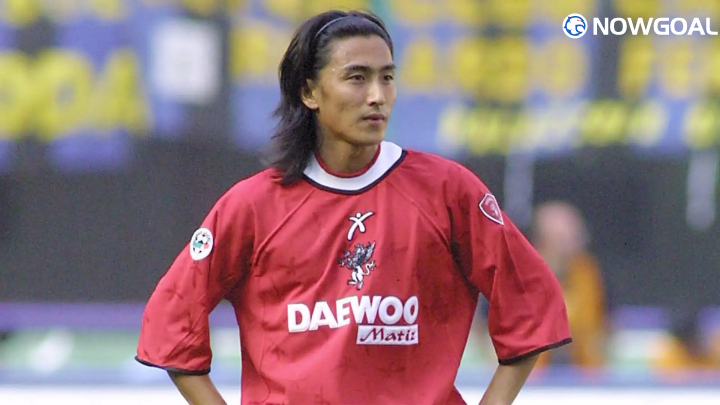
Ahn Jung-hwan during his time at Perugia Calcio
Leaving aside whether Luciano Gaucci’s other comments were justified, his claim that the club had “treated Ahn with love” was highly questionable. When Ahn joined Perugia, the team captain was Marco Materazzi. Materazzi reportedly once shouted at Ahn in the dressing room, saying that he “smelled of garlic.” At the time, Ahn could not understand Italian, and even the interpreter initially hesitated to translate the insult for him. The incident deeply hurt Ahn’s self-esteem, and afterward he reportedly became afraid to eat foods containing garlic. What Ahn experienced in Italy, therefore, was not exactly “love,” but discrimination. Gaucci’s later remarks were widely viewed as another example of that attitude.
In reality, however, Gaucci’s comments represented only his personal views. Perugia could not simply “fire” Ahn because he was still officially on loan from the Korean club Busan IPark. In fact, according to the terms of the agreement, Perugia were obligated to complete a permanent transfer if they wished to part ways with him. As a result, instead of terminating his contract, the club actually exercised the purchase option and signed him permanently.
Yet after hearing the club owner’s remarks, Ahn felt that his dignity had already been seriously damaged. Worse still, Gaucci’s statements inflamed some Italian fans. Ahn’s car was vandalized, and he even reportedly received death threats from criminal groups. Because of this hostile atmosphere, he refused to return to the club.
At the time, English side Blackburn Rovers FC showed interest in signing him, but Perugia demanded a £3 million transfer fee, which scared Blackburn away. Eventually, a Japanese entertainment company paid the fee and enabled Ahn to join Shimizu S-Pulse in Japan.
That goal against Italy completely changed the course of Ahn Jung-hwan’s career. He might have spent many more years playing in Europe, but his European journey effectively ended there. Looking back afterward, however, Ahn still said:“I would trade my entire career for that goal.”
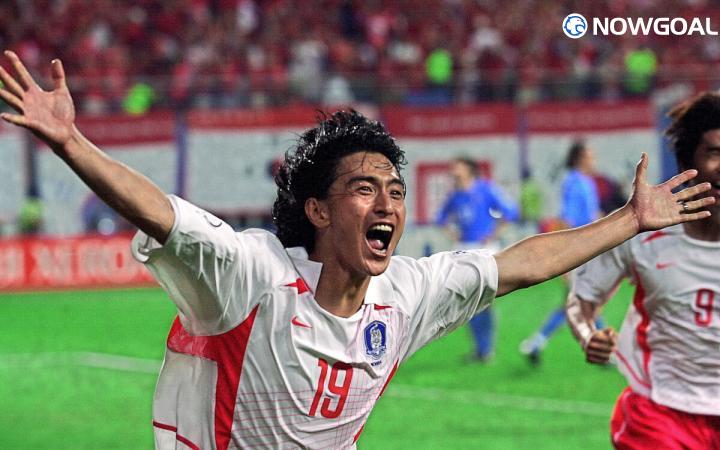
Ahn Jung-hwan’s goal against Italy effectively brought his European career to an end
After Italy were eliminated and returned home, the team landed at Milan Malpensa Airport. Unlike the infamous scenes after their shock defeat to North Korea in 1966, the players were not greeted by angry fans throwing rotten tomatoes. This time, almost all Italian fans and media believed the main reason for the elimination was that the team had been “robbed” by the referees.
Besides the controversial decisions already mentioned, many observers also felt South Korea’s challenges during the match were excessively aggressive. Yoo Sang-chul struck Italian defender Francesco Coco with an elbow, opening a cut near his eye and causing bleeding. Kim Tae-young also appeared to deliberately elbow Italian forward Alessandro Del Piero. Meanwhile, Lee Chun-soo even kicked Paolo Maldini in the head while contesting the ball after Maldini had fallen to the ground. Referee Byron Moreno ignored all of these incidents. Ironically, nine years later, Moreno was imprisoned in New York for drug smuggling.
At the time, a joke circulated widely in Italy:A boy walks into a football shirt shop and says he wants to buy a South Korea jersey.
The shop assistant replies: “No problem. But do you want the player version, or the referee version?”South Korea’s opponents in the quarter-finals were Spain national football team, with the match taking place at the Gwangju World Cup Stadium. Once again, controversy followed the game. In the second half, Spanish midfielder Rubén Baraja scored with a header, but Egyptian referee Gamal Al-Ghandour ruled the goal out for an alleged foul inside the penalty area. Replays showed that both Baraja and the Korean defender marking him were pulling at each other during the challenge.
The goal scored by Rubén Baraja that was ruled out
The match remained 0–0 after normal time and went into extra time. Early in the first half of extra time, Spanish winger Joaquín delivered a cross from near the right byline. Inside the box, Spanish striker Fernando Morientes rose highest and headed the ball into the Korean net. However, the assistant referee raised his flag, ruling that the ball had already crossed the goal line before Joaquín’s cross. Replays clearly showed that the ball was still touching the line and had not fully gone out of play.
Joaquín’s cross led to a Morientes goal, but it was disallowed because the ball was judged to have gone out beforehand.
In the second half of extra time, Spain broke forward on a dangerous counterattack and appeared to have another clear one-on-one opportunity, only for the assistant referee to flag for offside once again. Television replays suggested that decision was also debatable. In the end, neither side could score in 120 minutes, and the match went to a penalty shootout.
Amid the deafening roar of the home crowd, South Korea converted all five penalties. Spain’s injured winger Joaquín saw his spot kick saved by Korean goalkeeper Lee Woon-jae. With that, South Korea made history by becoming the first — and still the only — Asian team to reach the semi-finals of a FIFA World Cup.
After the match, Spanish midfielder Iván Helguera was furious and attempted to confront the referee before being restrained by team staff. He later said publicly:“What happened here was robbery. Everyone saw two completely legitimate goals. If Spain did not win, it was because they did not want us to win. I am extremely disappointed with this match.”Once South Korea reached the semi-finals, however, their “miracle run” finally came to an end. Their opponents were Germany national football team, a side without many superstars but one that relied on strong teamwork and consistency. Germany’s midfield leader was Michael Ballack of Bayer 04 Leverkusen. In the 71st minute, Ballack received a yellow card, meaning that even if Germany reached the final, he would be suspended for it.
Despite the disappointment, Ballack quickly regained his focus. Just four minutes later, in the 75th minute, he scored the winning goal with a close-range rebound, helping Germany defeat the hosts 1–0 and advance to the final.
South Korea later lost 3–2 to Turkey national football team in the third-place playoff. During that match, Turkish striker Hakan Şükür scored after only 10.8 seconds — still the fastest goal in World Cup history.
Hakan Şükür scored the fastest goal in FIFA World Cup history.
In the end, South Korea finished fourth on home soil, an achievement widely regarded as miraculous and one that remains difficult for other Asian teams to match. However, the manner in which that Korean side achieved its success was surrounded by controversy, ensuring that the accomplishment would continue to be questioned for years to come.
2002 FIFA World Cup logo
Group A: France, Denmark, Uruguay, Senegal
Group B: Spain, Slovenia, Paraguay, South Africa
Group C: Brazil, Turkey, China, Costa Rica
Group D: South Korea, Poland, Portugal, United States
Group E: Germany, Republic of Ireland, Saudi Arabia, Cameroon
Group F: Argentina, England, Sweden, Nigeria
Group G: Italy, Croatia, Ecuador, Mexico
Group H: Japan, Belgium, Russia, Tunisia
There were four debutants at the 2002 FIFA World Cup: Ecuador, Senegal, Slovenia, and China. Among them, China attracted the most attention.
China’s qualification for the World Cup was the result of several factors coming together. First, co-hosts South Korea and Japan qualified automatically, which meant China avoided two major rivals in the Asian qualifiers. In addition, during the final round draw of the Asian qualifying tournament, Zhang Jilong, then vice chairman of the AFC competition committee, helped China land a highly favorable group, allowing them to avoid strong teams such as Iran and Saudi Arabia and greatly reducing the pressure on the team.
At the same time, the Chinese national team itself had reached a respectable level of strength, while head coach Bora Milutinović did an excellent job preparing the players mentally. As a result, China qualified for the FIFA World Cup finals for the first time in history, an achievement that many saw as a natural culmination of the team’s progress.
Bora Milutinović led China to qualify for the FIFA World Cup for the first time in the nation’s history
Before the tournament, the Chinese team set themselves the goal of “scoring one goal, earning one point, and winning one match.” They believed they had a chance to defeat Costa Rica, draw with Turkey, and narrowly lose to Brazil, which could have been enough to qualify from the group in second place. However, once the matches began, China quickly realized the enormous gap between themselves and the world’s top footballing nations. In the end, China lost all three matches, conceded nine goals, and failed to score even once before being eliminated. Had Saudi Arabia not suffered an even worse campaign, China would have finished bottom of the overall standings at the tournament.
Although both China and Saudi Arabia endured heavy defeats, Asian football as a whole achieved a breakthrough at the 2002 World Cup. Japan, only participating in their second World Cup, reached the Round of 16. South Korea, who had never previously won a World Cup match in five earlier appearances, stunned the world by reaching the semi-finals. However, their historic run was also accompanied by major controversy.
One year before the Korea–Japan World Cup, the Korea Football Association appointed renowned Dutch coach Guus Hiddink as head coach of the national team. During his time managing PSV Eindhoven, Hiddink had won the UEFA Champions League and achieved a historic continental treble. He also briefly managed Spanish giants Real Madrid CF. Yet his reputation and résumé did not make him untouchable. Korean media were initially dissatisfied with his management, criticizing him for not appearing fully committed to the job.
At first, South Korea’s performances under Hiddink were indeed disappointing. In the 2001 FIFA Confederations Cup, they suffered a humiliating 5–0 defeat to France. In 2002, as a guest team invited to the CONCACAF Gold Cup, they played five matches and lost three of them. At the time, there were even public calls for Hiddink to be dismissed before the World Cup. Nevertheless, he ignored the outside pressure and continued carrying out his plans step by step.
Guus Hiddink achieved tremendous success as head coach of South Korea
Korean football culture traditionally placed great importance on seniority. Within the national team, veteran players tended to stay together while younger players formed their own separate groups. Hiddink deliberately broke down these divisions, encouraging older and younger players to interact more often and speak openly about their ideas. In this way, he strengthened the team’s unity and cohesion. He also placed enormous emphasis on physical conditioning so that Korean players could maintain their intensity throughout high-level matches. Later events proved that South Korea’s superior fitness became one of their greatest weapons.
In the group stage, South Korea defeated Poland 2–0, drew 1–1 with the United States, and beat Portugal 1–0 to finish top of the group and advance to the Round of 16. One particularly notable moment came in the match against Portugal, where the referee sent off two Portuguese players. The first red card caused little controversy, as midfielder João Pinto committed a reckless tackle from behind on Park Ji-sung.
The second dismissal, however, sparked debate. Portuguese defender Beto was judged to have fouled Korean full-back Lee Young-pyo and received a second yellow card. Replays suggested that Lee may have exaggerated the contact and possibly simulated the foul. Forced to play with only nine men from the 66th minute onward, Portugal eventually conceded the decisive goal to Park Ji-sung, lost the match, and were eliminated from the tournament.
In the Round of 16, South Korea faced Italy at the Daejeon World Cup Stadium. Korean fans displayed a striking banner in the stands that read:
“Back to 1966”
Korean fans displayed banners reading “Back to 1966.”
At the 1966 World Cup, Italy had suffered a shocking 1–0 defeat to North Korea, South Korea’s compatriots on the Korean Peninsula. That match became such a nightmare for Italian football that even the word “Korea” could trigger painful memories among Italian fans. To make matters worse, Italy entered this game without two key central defenders: Alessandro Nesta was injured, while Fabio Cannavaro was suspended. Their absence created major concerns in defense.
Sure enough, just four minutes into the match, Italian defender Christian Panucci conceded a penalty. South Korean striker Ahn Jung-hwan stepped up to take it, but his shot was saved by legendary Italian goalkeeper Gianluigi Buffon. Having escaped early danger, Italy soon took the lead when Christian Vieri scored with a header. After scoring, Vieri faced the roaring home crowd and put his finger to his lips in a “quiet down” gesture.
In the second half, South Korea became increasingly aggressive as they pushed for an equalizer, while Italy gradually retreated deeper in an attempt to protect their lead. Then, in the 88th minute, trouble struck Italy again through Panucci. While trying to clear a Korean cross, he accidentally tripped his own teammate. Korean forward Seol Ki-hyeon seized the opportunity and fired home the equalizer.
The match went into extra time. In the 103rd minute, controversy erupted. Italian star Francesco Totti burst into the Korean penalty area and went down after making contact with Korean defender Song Chong-gug. Totti appealed for a penalty, but Ecuadorian referee Byron Moreno instead ruled that he had dived and showed him a yellow card. Since it was Totti’s second booking of the match, he was sent off.
Francesco Totti was judged to have dived and received his second yellow card of the match
Slow-motion replays showed that there was indeed physical contact between the players. Even if the incident was not enough to justify a penalty, many felt that accusing Totti of simulation was an extremely harsh decision—especially considering he had already been booked once and that sending him off would have a decisive impact on the match. Nevertheless, referee Byron Moreno did not hesitate and chose to dismiss him.
Soon afterward, Italy faced another controversial moment. Italian midfielder Damiano Tommasi broke through one-on-one with the goalkeeper, only for the move to be stopped for offside. Replays strongly suggested that the decision may have been incorrect, denying Italy an excellent scoring opportunity.
As time ticked away, both teams appeared to be preparing for a penalty shootout. Then, with only three minutes remaining in extra time, Korean full-back Lee Young-pyo delivered a long ball into the penalty area. Striker Ahn Jung-hwan leapt high to challenge for it. At first, Ahn thought he had jumped too early and might miss the ball altogether. However, Italian defensive legend Paolo Maldini misjudged the timing of his jump, allowing Ahn to reach the ball first. Ahn powered a header past the goalkeeper and into the net.
Under the rules at the time, the match was decided immediately by the “golden goal” rule. South Korea advanced to the quarter-finals, and the historic victory sparked enormous celebrations, with millions of Korean fans flooding the streets of Seoul.
Ironically, Ahn Jung-hwan, the hero who eliminated Italy, was at that time playing for Italian club Perugia Calcio. Because of this, he soon became the center of a major controversy. Perugia owner Luciano Gaucci publicly declared:“Ahn Jung-hwan must never set foot in Perugia again. He only decided to play like a superstar against Italy. This behavior not only hurt our national pride, but also insulted the country that welcomed him two years ago. I have no intention of paying the salary of someone who destroyed Italian football!”Gaucci’s comments immediately drew widespread criticism, with some accusing him of racism. Then AFC president Peter Velappan angrily responded:“If he really does that, I will put them on a blacklist. I have already told football officials in Japan, South Korea, and China not to send players to Perugia. This is extremely rude and a typical Italian reaction.”Guus Hiddink also criticized Gaucci’s remarks publicly:“These comments are childish. Athletes represent different countries. Marcel Desailly plays for Chelsea FC—does that mean he should not score against England?”Facing mounting criticism, Gaucci later softened his stance and changed his explanation:“I did not say this because Ahn scored against Italy. Even if he had scored ten goals, I would not have felt insulted. What I objected to were his comments after the match. Ahn said Korean football was superior to Italian football. We treated him with kindness, but those remarks offended both me and the Italian people. He should respect other countries just as he respects his own.”
Ahn Jung-hwan during his time at Perugia Calcio
Leaving aside whether Luciano Gaucci’s other comments were justified, his claim that the club had “treated Ahn with love” was highly questionable. When Ahn joined Perugia, the team captain was Marco Materazzi. Materazzi reportedly once shouted at Ahn in the dressing room, saying that he “smelled of garlic.” At the time, Ahn could not understand Italian, and even the interpreter initially hesitated to translate the insult for him. The incident deeply hurt Ahn’s self-esteem, and afterward he reportedly became afraid to eat foods containing garlic. What Ahn experienced in Italy, therefore, was not exactly “love,” but discrimination. Gaucci’s later remarks were widely viewed as another example of that attitude.
In reality, however, Gaucci’s comments represented only his personal views. Perugia could not simply “fire” Ahn because he was still officially on loan from the Korean club Busan IPark. In fact, according to the terms of the agreement, Perugia were obligated to complete a permanent transfer if they wished to part ways with him. As a result, instead of terminating his contract, the club actually exercised the purchase option and signed him permanently.
Yet after hearing the club owner’s remarks, Ahn felt that his dignity had already been seriously damaged. Worse still, Gaucci’s statements inflamed some Italian fans. Ahn’s car was vandalized, and he even reportedly received death threats from criminal groups. Because of this hostile atmosphere, he refused to return to the club.
At the time, English side Blackburn Rovers FC showed interest in signing him, but Perugia demanded a £3 million transfer fee, which scared Blackburn away. Eventually, a Japanese entertainment company paid the fee and enabled Ahn to join Shimizu S-Pulse in Japan.
That goal against Italy completely changed the course of Ahn Jung-hwan’s career. He might have spent many more years playing in Europe, but his European journey effectively ended there. Looking back afterward, however, Ahn still said:“I would trade my entire career for that goal.”
Ahn Jung-hwan’s goal against Italy effectively brought his European career to an end
After Italy were eliminated and returned home, the team landed at Milan Malpensa Airport. Unlike the infamous scenes after their shock defeat to North Korea in 1966, the players were not greeted by angry fans throwing rotten tomatoes. This time, almost all Italian fans and media believed the main reason for the elimination was that the team had been “robbed” by the referees.
Besides the controversial decisions already mentioned, many observers also felt South Korea’s challenges during the match were excessively aggressive. Yoo Sang-chul struck Italian defender Francesco Coco with an elbow, opening a cut near his eye and causing bleeding. Kim Tae-young also appeared to deliberately elbow Italian forward Alessandro Del Piero. Meanwhile, Lee Chun-soo even kicked Paolo Maldini in the head while contesting the ball after Maldini had fallen to the ground. Referee Byron Moreno ignored all of these incidents. Ironically, nine years later, Moreno was imprisoned in New York for drug smuggling.
At the time, a joke circulated widely in Italy:A boy walks into a football shirt shop and says he wants to buy a South Korea jersey.
The shop assistant replies: “No problem. But do you want the player version, or the referee version?”South Korea’s opponents in the quarter-finals were Spain national football team, with the match taking place at the Gwangju World Cup Stadium. Once again, controversy followed the game. In the second half, Spanish midfielder Rubén Baraja scored with a header, but Egyptian referee Gamal Al-Ghandour ruled the goal out for an alleged foul inside the penalty area. Replays showed that both Baraja and the Korean defender marking him were pulling at each other during the challenge.
The goal scored by Rubén Baraja that was ruled out
The match remained 0–0 after normal time and went into extra time. Early in the first half of extra time, Spanish winger Joaquín delivered a cross from near the right byline. Inside the box, Spanish striker Fernando Morientes rose highest and headed the ball into the Korean net. However, the assistant referee raised his flag, ruling that the ball had already crossed the goal line before Joaquín’s cross. Replays clearly showed that the ball was still touching the line and had not fully gone out of play.
Joaquín’s cross led to a Morientes goal, but it was disallowed because the ball was judged to have gone out beforehand.
In the second half of extra time, Spain broke forward on a dangerous counterattack and appeared to have another clear one-on-one opportunity, only for the assistant referee to flag for offside once again. Television replays suggested that decision was also debatable. In the end, neither side could score in 120 minutes, and the match went to a penalty shootout.
Amid the deafening roar of the home crowd, South Korea converted all five penalties. Spain’s injured winger Joaquín saw his spot kick saved by Korean goalkeeper Lee Woon-jae. With that, South Korea made history by becoming the first — and still the only — Asian team to reach the semi-finals of a FIFA World Cup.
After the match, Spanish midfielder Iván Helguera was furious and attempted to confront the referee before being restrained by team staff. He later said publicly:“What happened here was robbery. Everyone saw two completely legitimate goals. If Spain did not win, it was because they did not want us to win. I am extremely disappointed with this match.”Once South Korea reached the semi-finals, however, their “miracle run” finally came to an end. Their opponents were Germany national football team, a side without many superstars but one that relied on strong teamwork and consistency. Germany’s midfield leader was Michael Ballack of Bayer 04 Leverkusen. In the 71st minute, Ballack received a yellow card, meaning that even if Germany reached the final, he would be suspended for it.
Despite the disappointment, Ballack quickly regained his focus. Just four minutes later, in the 75th minute, he scored the winning goal with a close-range rebound, helping Germany defeat the hosts 1–0 and advance to the final.
South Korea later lost 3–2 to Turkey national football team in the third-place playoff. During that match, Turkish striker Hakan Şükür scored after only 10.8 seconds — still the fastest goal in World Cup history.
Hakan Şükür scored the fastest goal in FIFA World Cup history.
In the end, South Korea finished fourth on home soil, an achievement widely regarded as miraculous and one that remains difficult for other Asian teams to match. However, the manner in which that Korean side achieved its success was surrounded by controversy, ensuring that the accomplishment would continue to be questioned for years to come.
The Most Popular
-
 Indonesia U19 Squad Boosted by Seven Overseas Talents Ahead of ASEAN Championship
 -
 Atletico Madrid Move Closer to Signing Wolves Midfield Star Joao Gomes
 -
 Chelsea Ready to Sacrifice Joao Pedro in Bold Pursuit of Victor Osimhen
 -
 Ajax Defender Tristan Gooijer Opens Door to Future with Indonesia National Team
 -
 Italy's Coaching Race Intensifies as Mancini Eyes Stunning Return
 -
 Manchester United Circle Bowen and Fernandes as West Ham Fight for Survival
 Telegram
 Facebook
 X
X